Feed Forward Network
Propagating Signals to all Nodes in the Next Layer
Feed-forward neural networks process information in a single direction, moving from an input layer through one or more hidden layers to an output layer. Since information does not loop back during prediction, these networks are well suited to fixed-state data such as images, measurements, records, and category assessment tasks. They can identify whether an input belongs to a known class, estimate a numerical result, or determine relationships among variables within a dataset.
Network Functional Design
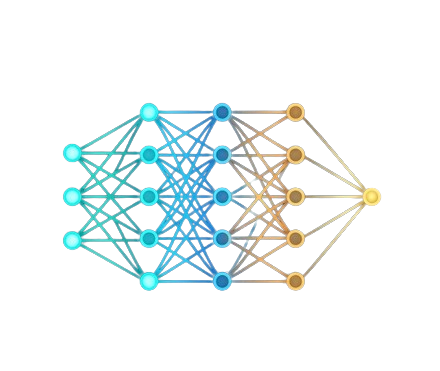
Conventional Network
Signals propagates forward forming an input output map.
Auto Encoder
Signals propagates forward forming an input output map.
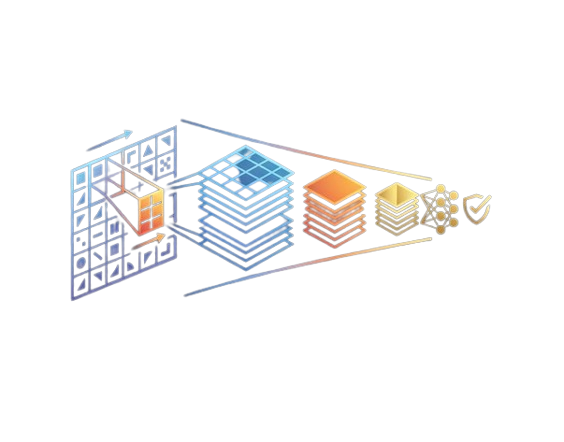
Conventional feed forward Neural Networks, Auto Encoders, and Convolutional Neural Networks represent three core evolutionary branches of feed forward architecture, all operating on the principle of unidirectional information flow from input to output. Standard neural networks rely on fully connected layers where every neuron receives input from all neurons in the preceding layer, making them effective for unstructured or tabular data. Cognitive neural network adapt this feed forward pipeline for grid-structured inputs like images by replacing full connectivity with local receptive fields and weight sharing via sliding kernels. Auto encoders, while utilizing either dense or convolutional feed forward layers, introduce a unique hourglass structural design that forces input data through a narrow bottleneck layer before reconstructing it.
The operational objectives and learning paradigms of these networks fundamentally dictate their internal transformations. Standard neural networks and cognitive neural networks are overwhelmingly trained via supervised learning, relying on explicit external targets—such as class labels or continuous numbers—to calculate prediction error during back propagation. In contrast, Auto encoders operate primarily via self-supervised learning, using the raw input itself as the target output. While an standard neural networks compresses feature representations indirectly through successive hidden layers and a cognitive neural network extracts spatial feature hierarchies across feature maps, an auto encoder explicitly learns an optimized, lower-dimensional latent representation by balancing compression in its encoder with reconstruction in its decoder.
Despite these structural and functional differences, all three architectures remain bound by the defining characteristics of feed forward neural networks. Each network performs feature extraction by cascading weighted sums through non-linear activation functions (such as ReLU or Sigmoid), and all three update their parameters using back propagation paired with gradient descent variants. Ultimately, cognitive behavioral network specialize feed forward design for spatial patterns, Auto encoders optimize it for representation learning and data compression, and standard neural networks serve as the foundational baseline for dense functional mapping.
Copyright © 2026 Scrut.Hut Game Studio, LLC. All Rights Reserved. Privacy Policy