Artificial Neural Network
Feature Extraction Mechanisms to Transform Data into Meaningful Representations
This technology, within regards of artificial neural networks, provide intelligent systems with the ability to learn from data. With repeated training, these networks can recognize patterns, assess data, predict outcomes, and support adaptive decision making in changing environments. Neural Networks converge signals to propagate data to transform feature space. The semantics are discriminated and processed by each node. This forms context by structuring, wherein the network predicts samples. The networks are trained from a data set and must conform to patterns, as they can adapt by conforming to learned information.
Functional Structuring of Neural Networks
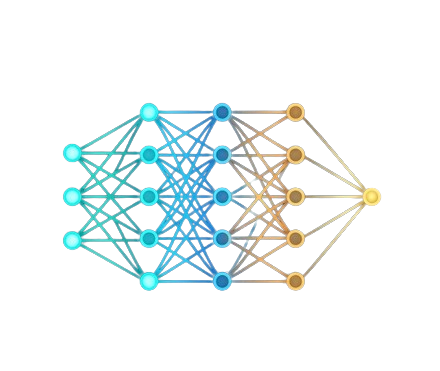
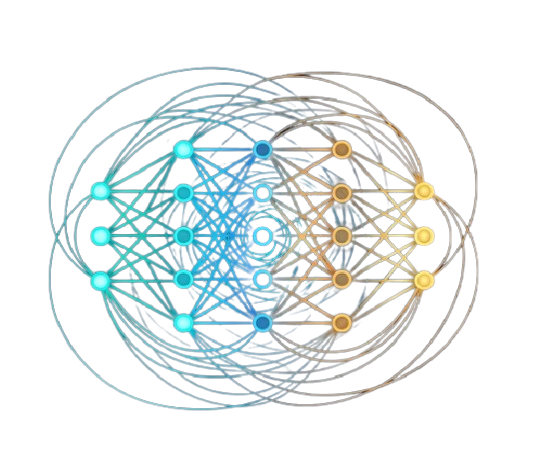

Artificial Neural Networks are computational models inspired by the biological structure of the human brain, designed to recognize patterns, solve complex problems, and learn from data. At their core, Neural Networks consist of interconnected processing units called artificial neurons arranged in layers. These systems take raw inputs such as numbers, text, audio, or image pixels and process them through non linear mathematical operations to map unstructured inputs into meaningful classifications, predictions, or generated outputs.
The internal structure of a standard neural network is divided into an input layer, one or more hidden layers, and an output layer. Raw data enters through the input layer and passes forward into the hidden layers. Within each hidden layer, neurons aggregate incoming values by multiplying them by adjustable weights, adding a baseline bias term, and firing the total through an activation function. This multi-layered structure allows the network to automatically extract hierarchy detecting simple features like edges or individual words in earlier layers, and assembling them into complex concepts like faces or full sentences in deeper layers.
Learning in neural networks relies on an iterative feedback loop driven by optimization algorithms. During the initial forward pass, the network makes a prediction, which is evaluated against target labels using a loss function to calculate prediction error. Through back propagation, the network computes how much each internal weight contributed to that error, using gradient descent to tune the weights in the direction of lower error. Over millions of training steps, this process refines the internal representations so the model can accurately generalize to unseen data.
Because of their ability to model non-linear relationships without manual feature engineering, artificial neural networks serve as the backbone for modern artificial intelligence. Specialized network architectures have been developed for targeted tasks: Convolutional Neural Networks excel at spatial image recognition, Recurrent Neural Networks process sequential temporal data, and Transformer architectures power large language models and generative AI. Today, drive real world systems ranging from medical imaging diagnostics and autonomous driving to natural language translation and financial forecasting.
Copyright © 2026 Scrut.Hut Game Studio, LLC. All Rights Reserved. Privacy Policy